Every few weeks, someone sends me the same email. Different company, different product, but the same question. “How much should we expect to pay to build our MVP?” I never give the same answer twice. But the shape of the answer is almost always the same, so I’ve finally written it down.
This is a practical breakdown of what an MVP actually costs in 2026 in the UK. No vague ranges like “£10k to £200k”. Real numbers, what you get for each, and where the cost goes.
What I mean by “MVP”
An MVP is not a finished product. It is also not a prototype. It is the smallest version of your product that a real user can use to get real value, and that you can ship to real customers to test whether anyone cares.
In 2026 that usually means:
- A working web app, mobile app, or both
- Real authentication, payments if relevant, a database, a backend
- Enough polish to not embarrass you in front of early customers
- Deployed to production with monitoring and crash reporting
- Handed over with documentation so you or someone else can keep building
What an MVP is not, and I mention this because clients often confuse the two:
- A clickable Figma prototype (that is a wireframe or design, not an MVP)
- A proof-of-concept behind a feature flag only your team can see
- The entire vision of your product with every feature included
If what someone is quoting you for does not match the first list, you are not being quoted for an MVP. You might be being quoted for less, which is fine if you know that going in. Or you are being quoted for more, which is where budgets disappear.
The four price tiers in 2026
Tier 0: Under £5,000
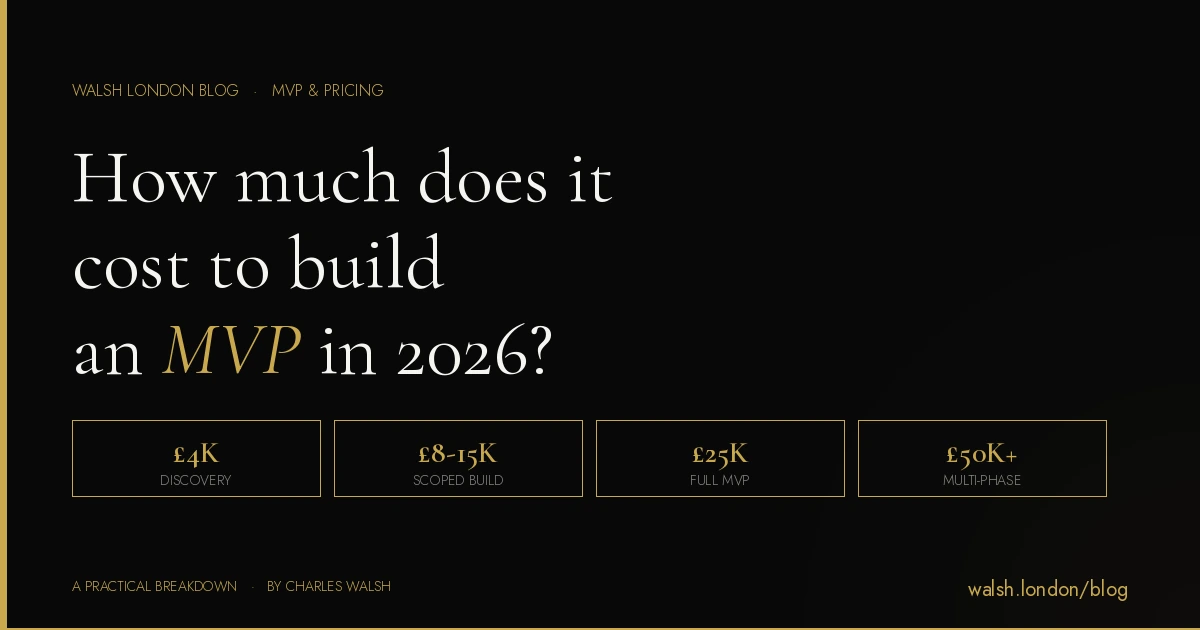
What you get: a Discovery Sprint or similar engagement that produces a written plan, wireframes, system design, and a costed roadmap. At Walsh London this is £4,000 for two weeks.
What you do not get: working software. You get the confidence to build the right thing, or the confidence not to build it.
When this is right: you are not sure what to build yet. You have a vague idea and a budget, and you want a senior engineer to poke holes in your assumptions before you commit £25,000.
Most solo founders I work with should start here. The two weeks almost always save ten times the cost down the line, either because the plan is sharper or because it becomes clear the original idea needed reshaping.
Tier 1: £8,000 to £15,000
What you get: a small, focused, working product. One platform (web or mobile, not both). Core features only, maybe three or four. Real deployment, but usually simpler infrastructure like Firebase or Supabase rather than custom AWS. Often no custom design system, leaning on a component library.
What you do not get: cross-platform apps. Complex integrations. Heavy backend logic. A polished marketing site. Ongoing support after launch unless you ask for it separately.
When this is right: you have a specific, well-understood use case. You already know who the users are. You do not need both iOS and Android on day one. You want something real shipped in six to eight weeks, not twelve.
This tier has grown enormously in 2026 because AI-assisted development has made it realistic to ship a tight focused product much faster than it used to be. A build that would have been £25,000 in 2022 is often £12,000 now. Not always, but often.
Tier 2: £20,000 to £35,000
What you get: a full MVP. Usually cross-platform (web and mobile, or iOS and Android). Custom backend, proper infrastructure, payments if relevant, authentication, real user flows beyond the happy path. Deployed to production. Submitted to the App Store and Play Store if mobile. Weekly demo cadence across the build.
At Walsh London this is our MVP Kickstart at £25,000 for twelve weeks. It is by far the most common engagement.
When this is right: you have funding or solid revenue, you know what you want to build, and you want the real thing shipped into real users’ hands in a quarter.
This is the tier where most serious startups land. If a quote comes in under this for a cross-platform build, it is almost always missing something important, which you will find out later when you ask for it. If a quote comes in significantly over this for what is essentially a standard MVP, you are paying for agency overhead, not engineering.
Tier 3: £50,000 and up
What you get: multi-phase delivery. Either a larger scope (a small marketplace, a regulated product, heavy integrations) or a staged build with multiple releases. Often includes a design phase with custom brand work. Includes ongoing support and a phase-two backlog.
When this is right: you are building something genuinely complex. Not because you want it to be complex, but because the domain is. Healthcare, fintech, marketplaces with real network effects, B2B SaaS with non-trivial data models. Or you have raised enough funding that speed-to-scale matters more than capital efficiency.
This tier needs honest scoping more than any other. It is also the tier where agencies most often over-quote, because fixed-scope £50k contracts have high margins if the agency has done something similar before.
What actually drives the cost up or down
Most of the cost of an MVP comes from six factors. Everything else is noise.
1. Platform count
Building for web only is the cheapest option. Mobile is roughly 1.5x web at the same feature scope. Cross-platform (web plus mobile, or iOS plus Android) roughly doubles the scope. Cross-platform mobile using React Native is the best compromise we have found. You ship to both app stores from a single codebase, which typically costs 1.3x a single mobile build rather than 2x.
2. Auth and payments
Auth is relatively cheap if you use a standard provider (Auth0, Supabase, Firebase, Clerk). It gets expensive when you need enterprise SSO or complex role-based access. Payments via Stripe or RevenueCat are cheap. Payments involving custom reconciliation, multi-party splits, or regulated flows are not.
3. Real-time or offline-first features
Anything that needs to work without a network connection, sync across devices, or update in real time adds real engineering time. Roughly 20 to 40 percent extra on top of the equivalent always-online build. Messaging, collaborative editing, live scoring, offline-capable apps all sit in this category.
4. Data complexity
A CRUD app with a few tables and straightforward relationships is cheap. An app that needs complex search, recommendations, aggregations, or analytics adds significant backend work. Vector search and RAG for AI features sits in this category and is often under-estimated.
5. Design and polish
A design system from scratch adds about £3,000 to £8,000 depending on depth. A well-designed app that uses existing design tokens and off-the-shelf component libraries adds much less. Clients often underestimate how much the “felt quality” of the app costs. It is not the last 10 percent of the work. It is more like the last 25.
6. Integrations
Every third-party integration costs real hours. Stripe, Firebase, an email provider are an hour or two each. Salesforce, a legacy enterprise API, a custom ERP are one to two weeks each. Ask specifically about integrations when you are comparing quotes.
The hidden costs nobody puts in quotes
Four real costs that will not appear in most quotes but you will pay:
Infrastructure and cloud. Once the app is live you are paying for hosting, database, email, file storage, monitoring, and so on. Budget £200 to £600 per month for a typical MVP in 2026, more if you use hosted AI services heavily.
App Store and Play Store fees. Apple takes £79 per year for the developer account. Google takes £20 one-off. Both take 15 to 30 percent of in-app purchases.
Design tool subscriptions. Figma, Adobe, icon libraries. Often included in the build cost but worth asking about explicitly.
Your time. MVP builds need an engaged client. Expect to spend two to four hours a week in demos, feedback, and decisions for the duration of the build. If you cannot, budget for someone who can.
Red flags when someone quotes you
A few things I have seen in client-shared quotes over the years that you should push back on:
“Fixed price, full MVP, £8,000”. Unless the scope is genuinely tiny, this is either a bait price that grows after signing, or work done by engineers who will struggle to deliver. The price-shopping phase of your buying process will not get you a better product.
Quotes with no weekly demos. If you cannot see working software every week, the engagement is structured badly. Walk away, regardless of price.
Vague scope and a high price. The quote should tell you what you are getting, not just a total. If the breakdown is four bullet points for £45,000, the scope is not defined. The cost will move.
No named engineer. “A team of engineers will deliver this” means the person on the call is not the person writing the code. For MVPs, that is nearly always the wrong structure. Ask who specifically is working on it and whether they will be on the weekly demo.
No code handover clause. All code, all documentation, all deployment credentials should be yours. If the contract does not say so, fix the contract.
What to ask before you pay
Five questions that sharpen any quote very quickly:
- “Who specifically is writing the code?” If the answer is “our team”, follow up until you get a name and a GitHub profile.
- “What happens at each weekly demo?” You want a cadence. “We’ll show you progress weekly” is fine. “We work in sprints, demo at the end” is also fine. “We’ll send updates as we go” is not fine.
- “What is explicitly out of scope?” A confident quote has an out-of-scope section. It protects you from surprises and them from scope creep.
- “What is the cost of changes during the build?” Every build has changes. You want to know the rate, the process, and whether minor changes are included.
- “What do I own at the end?” Source code, deployment credentials, design files, documentation. The answer should be “all of it”.
If the person quoting gets frustrated with these questions, you have your answer.
What it costs at Walsh London
For reference, our standard engagements:
- Discovery Sprint, £4,000 for two weeks. Wireframes, system design, costed roadmap, working technical shell, go/no-go recommendation.
- Scoped Build, from £8,000. Smaller, single-platform products in four to eight weeks.
- MVP Kickstart, from £25,000 for twelve weeks. Web, iOS, Android or a combination, full launch.
- Fractional CTO, from £5,000 per month. For teams that need ongoing technical leadership rather than a project.
Every engagement is scoped on a call before any fixed quote. The numbers above are starting points, not forced boxes. All prices shown are exclusive of VAT where applicable.
The short version
If you want a quick rule of thumb, here it is:
- Under £5k: plan, do not build.
- £8k to £15k: focused single-platform build, shipped fast.
- £25k: the default MVP, twelve weeks, cross-platform.
- £50k and up: only if the problem really is that complex.
If someone is quoting outside those ranges, ask more questions before you sign.